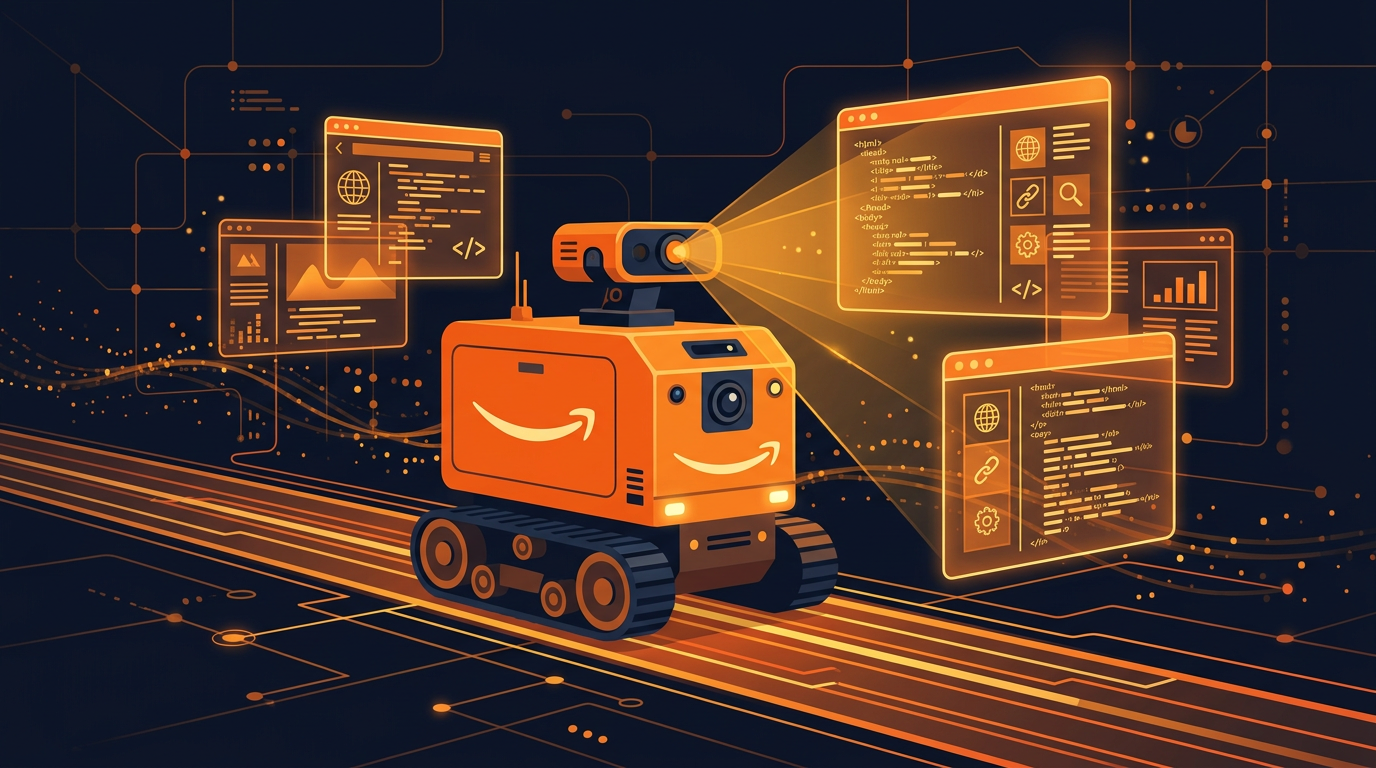

Amazon is not just an online store. It is also one of the world's largest AI companies, and its web crawler, Amazonbot, quietly crawls millions of websites every day. The data Amazonbot collects powers Alexa's AI-generated voice answers, Amazon's product search algorithms, and the newer Rufus AI shopping assistant. For website owners, understanding Amazonbot is important because Amazon's AI ecosystem reaches hundreds of millions of users daily.
In this guide, we will explain what Amazonbot is, how it works, what data it collects, and how it connects to Amazon's various AI services. We will also cover how to control Amazonbot access, whether you should allow or block it, and how it compares to other major AI crawlers.
Start by checking your current status. Use the free AI crawler checker to see whether Amazonbot can currently access your website.

What is Amazonbot?
Amazonbot is Amazon's official web crawler. It identifies itself with the user agent string Amazonbot/0.1 and crawls websites to collect content for Amazon's various AI and search services.
Amazon introduced Amazonbot in 2022, initially for powering Alexa voice responses. Since then, its role has expanded significantly. As of 2026, Amazonbot serves multiple purposes within Amazon's ecosystem:
Alexa AI voice answers: When users ask Alexa questions, Amazon uses web content to generate answers. Amazonbot collects the web data that feeds into Alexa's knowledge base.
Amazon product search: Amazonbot crawls product review sites, comparison pages, and expert content to improve Amazon's search results and product recommendations.
Rufus AI assistant: Amazon's AI shopping assistant, Rufus, uses web data to answer product questions, provide buying advice, and compare products. Amazonbot collects this data.
AI model training: Like other tech companies, Amazon uses web data to train its various AI models, including those powering AWS AI services and Amazon Bedrock.
Amazonbot's user agent string looks like this in your server logs:
# Amazonbot user agent string
Mozilla/5.0 (Macintosh; Intel Mac OS X 10_10_1)
AppleWebKit/600.2.5 (KHTML, like Gecko)
Version/8.0.2 Safari/600.2.5 (Amazonbot/0.1;
+https://developer.amazon.com/support/amazonbot)
Amazon's AI Ecosystem
To understand why Amazonbot matters, you need to understand the scale of Amazon's AI ecosystem. The data Amazonbot collects feeds into services used by hundreds of millions of people:

Alexa and voice search
Alexa is installed on hundreds of millions of devices worldwide, including Echo speakers, Fire TV, Fire tablets, and third-party devices. When users ask Alexa questions like "what is the best way to block AI crawlers?" or "how does robots.txt work?", Alexa often pulls answers from web content collected by Amazonbot.
Unlike screen-based search where users see a list of links, voice search typically provides a single answer. If your content is chosen as the source for that answer, Alexa may credit your website by saying "according to [your site]..." This voice attribution can build brand awareness, though it does not directly drive click traffic like web-based AI search.
Rufus AI shopping assistant
Rufus is Amazon's AI-powered shopping assistant, launched in 2024 and expanded in 2025 and 2026. It helps Amazon shoppers by answering product questions, comparing items, and providing buying recommendations. Rufus pulls from both Amazon's product database and external web content to give comprehensive answers.
For e-commerce websites and product review sites, Rufus is particularly relevant. If Amazonbot can access your product reviews, comparison articles, or buying guides, that content may be used by Rufus to help Amazon shoppers make purchasing decisions. This can indirectly influence which products shoppers choose, even if they do not visit your site directly.
Amazon search and recommendations
Amazon's product search engine uses web data to understand product categories, features, and user intent better. Amazonbot collects information from product review sites, comparison pages, and expert content to improve Amazon's search algorithms. If you publish content about products, Amazonbot likely visits your site regularly.
How Amazonbot Works
Amazonbot follows the standard web crawling protocol:
Robots.txt check. Before crawling, Amazonbot checks your robots.txt file for rules about its access. It generally respects these rules, though some website owners have reported occasional non-compliance.
Page fetching. Amazonbot downloads your web pages, including the HTML content and metadata. It renders JavaScript-heavy pages, similar to modern browsers.
Content extraction. The crawler extracts text, structured data, product information, pricing data, and other relevant content from each page.
Data distribution. Collected data is processed and distributed to various Amazon services: Alexa, product search, Rufus, and AI training pipelines.
Amazonbot's crawling behavior is generally moderate compared to more aggressive crawlers like ByteSpider. Most website owners report reasonable request rates and minimal server impact. However, high-traffic product review sites may see more frequent Amazonbot visits.
How to Control Amazonbot Access
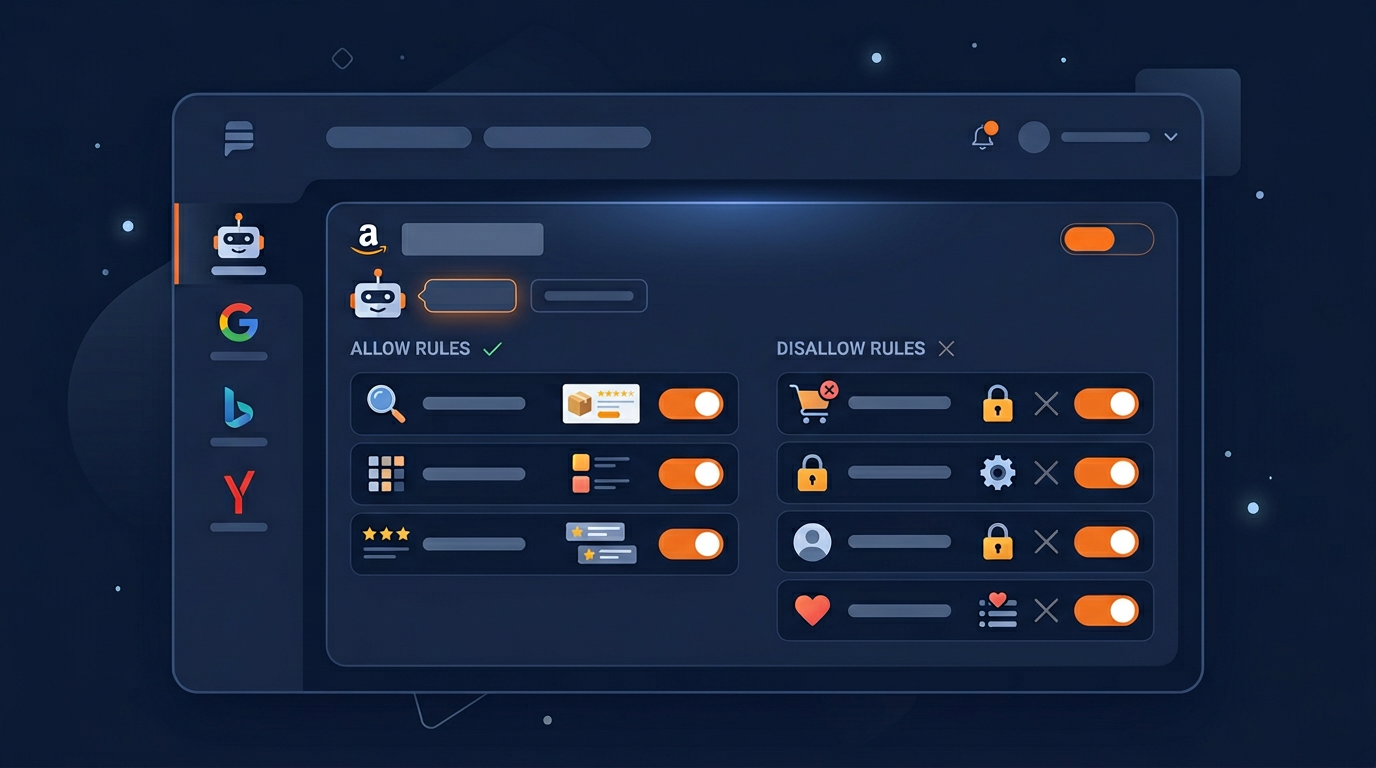
You have full control over Amazonbot through your robots.txt file. Here are the common configurations:
Block Amazonbot completely
# Block Amazonbot from all pages
User-agent: Amazonbot
Disallow: /
Allow Amazonbot with restrictions
# Allow Amazonbot to access public content only
User-agent: Amazonbot
Allow: /blog/
Allow: /products/
Disallow: /premium/
Disallow: /members/
Disallow: /api/
Allow full access
If you want maximum Amazon AI visibility, no special rules are needed. Amazonbot is allowed by default unless you specifically block it. Just make sure your robots.txt does not have a wildcard Disallow that catches it.
For a comprehensive configuration that includes Amazonbot and the other 70 AI crawlers we track, use the Robots.txt Generator tool.
Should You Allow or Block Amazonbot?
The decision depends on your website type and business goals. Here are recommendations for different scenarios:
E-commerce sites: Allow (recommended)
If you sell products, Amazonbot helps your products and brand appear in Amazon's search and Rufus recommendations. Even if you sell outside of Amazon, being part of Amazon's product knowledge graph can drive awareness.
Product review sites: Allow with caution
Your reviews may be used by Rufus to help Amazon shoppers. This can be beneficial for brand awareness, but your content essentially helps Amazon sell products without sending traffic to your site. Consider allowing access to some content while restricting premium reviews.
Content publishers: Your choice
If your content is not product-focused, the benefit of allowing Amazonbot is mainly Alexa voice search visibility. If Alexa mentions your brand as a source, it builds awareness. But if you prefer to protect your content, blocking is reasonable.
Premium content sites: Block (recommended)
If you sell access to your content (paywalled articles, courses, premium data), blocking Amazonbot prevents your premium content from being freely distributed through Amazon's AI services.
Amazonbot vs. Other AI Crawlers
Here is how Amazonbot compares to other major AI crawlers:
| Crawler | Company | Primary Use | Server Impact | robots.txt |
|---|---|---|---|---|
| Amazonbot | Amazon | Alexa, Rufus, search | Moderate | Respects |
| GPTBot | OpenAI | AI training | Moderate | Respects |
| ChatGPT-User | OpenAI | Real-time search | Low | Respects |
| ClaudeBot | Anthropic | Training + search | Moderate | Respects |
| PerplexityBot | Perplexity | AI search | Moderate | Respects |
| Bytespider | ByteDance | AI training | High | Sometimes |
Amazonbot falls in the middle of the spectrum. It is less aggressive than ByteSpider and less frequent than CCBot, but it crawls more regularly than on-demand search crawlers like ChatGPT-User.
Optimizing for Amazon's AI
If you decide to allow Amazonbot, here are ways to improve your chances of being cited by Amazon's AI services:
Use Product schema markup: If you have product pages, implement Product schema with prices, ratings, and availability. This helps Amazonbot understand your product content.
Write detailed product information: Rufus and Alexa prefer content with specific details, comparisons, and clear recommendations. Vague or thin content is less likely to be cited.
Answer common questions: Alexa voice search responds to question-based queries. Structure your content to answer specific questions clearly. FAQ sections are particularly effective.
Keep content fresh: Amazon's AI services prefer current information. Update your pages regularly with new data, prices, and recommendations.
Create an llms.txt file: An llms.txt file helps all AI systems (including Amazon's) understand your website's purpose, expertise, and key content.
Monitoring Amazonbot in Server Logs
To understand how Amazonbot interacts with your site, check your server logs:
# Count Amazonbot requests in the last 24 hours
grep "Amazonbot" /var/log/nginx/access.log | wc -l
# See which pages Amazonbot visits most
grep "Amazonbot" /var/log/nginx/access.log |
awk '{print $7}' | sort | uniq -c | sort -rn | head -20
# Check Amazonbot response codes
grep "Amazonbot" /var/log/nginx/access.log |
awk '{print $9}' | sort | uniq -c | sort -rn
If you see an unusually high number of requests or if Amazonbot is consuming too much bandwidth, consider implementing rate limiting specifically for Amazonbot. A crawl-delay of 5 to 10 seconds in your robots.txt is usually sufficient to keep request volumes reasonable.
Use see which AI crawlers access your site to get a quick overview of your Amazonbot access status alongside all other AI crawlers.
The Future of Amazon's AI Crawling
Amazon is investing heavily in AI across all its services. Here is what to expect from Amazonbot in the coming years:
More frequent crawling: As Rufus and Alexa AI expand, Amazonbot will likely increase its crawling frequency to keep its knowledge base current.
Separate crawlers: Amazon may follow the pattern set by Google, OpenAI, and Apple by creating separate crawlers for different purposes (search vs. training). This would give website owners more granular control.
E-commerce integration: Expect deeper integration between Amazonbot and Amazon's shopping ecosystem, with AI-powered product recommendations becoming more reliant on web data.
AWS AI services: Amazon Bedrock and other AWS AI services may benefit from Amazonbot data, potentially making your content part of the broader Amazon AI infrastructure.
Key Takeaways
Amazonbot powers Alexa AI, Rufus shopping assistant, and Amazon product search.
It respects robots.txt and can be blocked or restricted per directory.
E-commerce and product review sites generally benefit from allowing Amazonbot.
Server impact is moderate, less aggressive than ByteSpider but more frequent than on-demand crawlers.
Use Product schema markup and FAQ sections to optimize for Amazon's AI services.
Monitor Amazonbot activity in server logs and use rate limiting if needed.
Use the Robots.txt Generator to configure Amazonbot alongside all 196+ AI crawlers.
Check Your Amazonbot Status
See if Amazonbot and the other 70 AI crawlers we track can access your website.
Scan Your Website Now