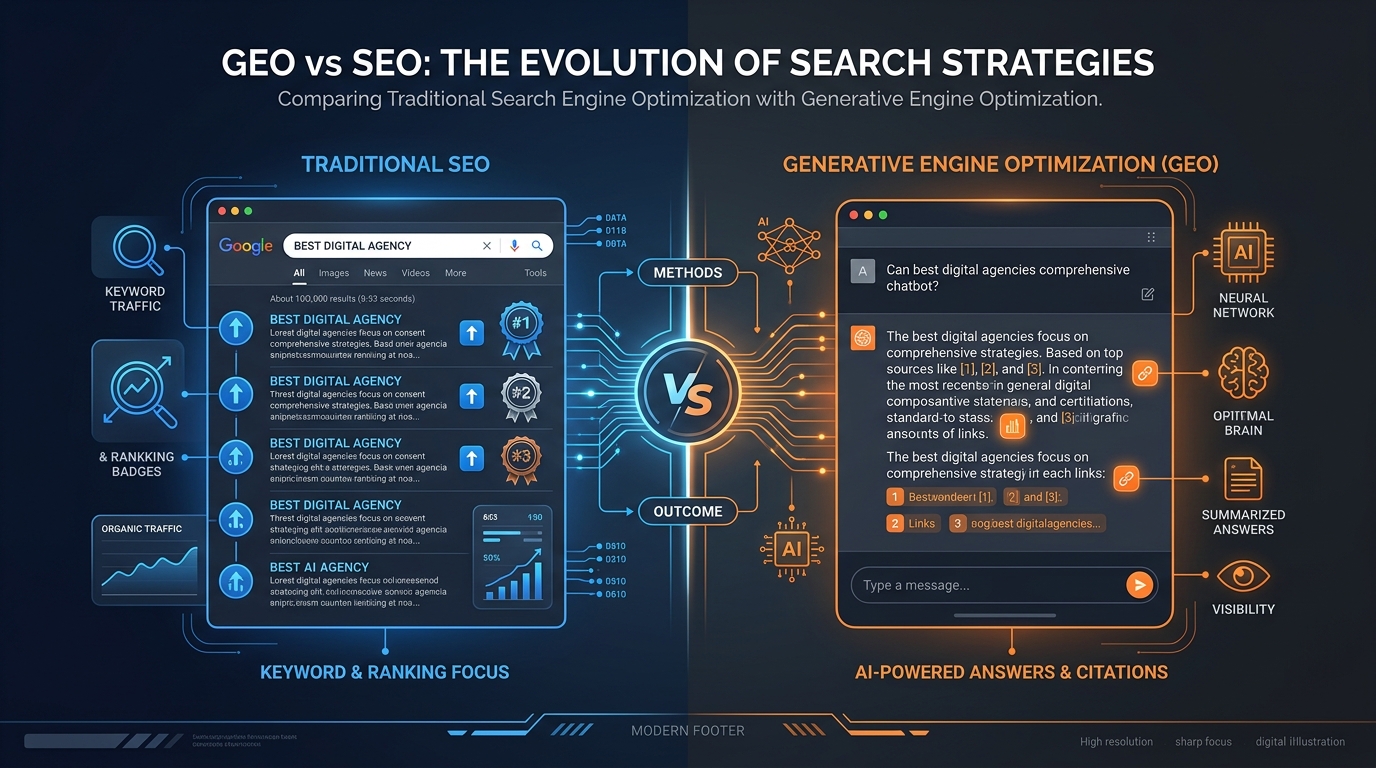

Generative Engine Optimization (GEO) is the practice of getting your content cited in AI-generated answers. It is not a replacement for SEO. It is the next layer on top of it.
In this guide you will learn how to lead with answers to win AI citations. We will keep it practical, with clear steps, visual breakdowns, and specific actions you can take today. The first step in any AI visibility project is to run a free AI crawler check on your website so you know exactly where you stand against the 196 bots we track across 8 categories.
Key Takeaways
- GEO and SEO share most of their foundation, but the differences decide AI citations.
- Citability, authority, and crawl access are the three pillars that matter most.
- You can measure progress with an AI Visibility Score and AI referral tracking.
- Start with a free baseline using the free AI crawler check.
What the Standard Advice on Answer-First Structure Misses
Answer-first gets taught as a formatting rule: put a summary box at the top and you are done. That produces pages with a tidy summary followed by the original meandering article, which satisfies the rule and fixes nothing, because the summary is usually too general to be quoted and the body still buries every specific. The instruction is really about where the substance lives in a document, and a box at the top is only the visible symptom of having done it properly.
Answer-first structure works on a page because it front-loads the substance at every level, not just the top. Each section should open with its own conclusion, each paragraph with its own point, and the page with the answer to the question in the title. That nesting is what makes the structure robust to a retrieval process that may take any chunk from anywhere in the document, since wherever the boundary falls, the piece before it began with something worth keeping. A single summary block at the top gives you exactly one good chunk and leaves the rest of the page as unquotable as before.
What to Settle About Answer-First Structure, in Order
Answer the title question in the first paragraph, in full, without hedging
If the title asks something, the opening paragraph should answer it outright rather than promising to explain later. The instinct to build up to the answer comes from wanting the reader to stay, and it costs you the one passage most likely to be retrieved for the query the title targets. Give the answer, then spend the rest of the page on the conditions, the exceptions and the how, which is the material that makes the page worth reading after the answer is known.
Write headings that state a conclusion rather than name a topic
A heading reading Considerations tells nobody anything, and a heading stating the conclusion of the section that follows does real work twice: it helps a reader deciding whether to read on, and it gives a passage boundary a meaningful label. This is also the cheapest structural edit available on an existing page, because it changes no argument and requires no new research. Compare your current heading list against the questions you want the page to answer, and the gaps are usually obvious immediately.
Put the qualification after the claim, not before it
Careful writers tend to establish the conditions first and state the conclusion once the ground is prepared, which inverts the useful order. If a chunk boundary lands early, that structure yields a passage of setup with no conclusion, which is worthless to a retrieval step and unsatisfying to a reader. State the claim, then immediately narrow it. The result is no less rigorous, because the qualification is still in the same paragraph, and it survives being cut in a way the other order does not.
Do not let a summary box substitute for restructuring the body
The summary at the top is genuinely useful and it is also the easiest part to fake. A box containing generalities above an unchanged article produces a page that looks modernised and behaves exactly as before. The test is whether the body could survive without the box: if deleting the summary would leave a reader unable to find the answer quickly, the answer was never actually distributed through the page and the box was hiding that.
The Costliest Way to Get Your Answer-First Structure Wrong
Adding a summary block to the top of every page and treating the migration as finished
The reason this is the dominant failure is that it is measurable progress by the wrong measure. Coverage of summary boxes across the site goes to a hundred percent, the work is reported as complete, and the underlying property nobody measured, which is whether an arbitrary passage from the middle of a page carries a complete thought, is unchanged. Pages then keep getting passed over for reasons the summary box cannot address, and because the box is visible and the structural problem is not, the conclusion drawn is usually that answer-first does not work. Restructure a small number of important pages properly and compare them against the boxed ones before rolling anything out sitewide.
A Single Question That Tests Answer-First Structure
The check that matters here: Open an important page, read only the headings, and see whether they alone answer the question in the title. Then read the first sentence of each section and check that each one states a conclusion rather than introducing a topic. Those two passes measure whether the structure is real or decorative.
Where to Go From Here
Answer-First Structure is one piece of a larger picture. The AI bot directory documents every crawler we track with its operator, purpose and safety rating, and the batch checker audits many sites in one pass if you manage a portfolio.
Turn the guidance above into a concrete change, then confirm it worked. A crawler check shows you exactly which of the 196 bots can reach your content today.
Your Answer-First Structure Action Checklist
Five concrete steps, specific to what this guide covered. Work through them in order, changing one thing at a time so you can tell which change produced the result.
- □Establish a baseline with an AI crawler access checker and write down the score before you change anything.
- □Apply the single highest-impact change from this guide, on its own, so you can attribute the result.
- □Validate the change with the robot checker before it reaches production.
- □Re-measure and compare against your baseline rather than against expectation.
- □Schedule a recurring re-check, because redesigns and security updates quietly undo this work.