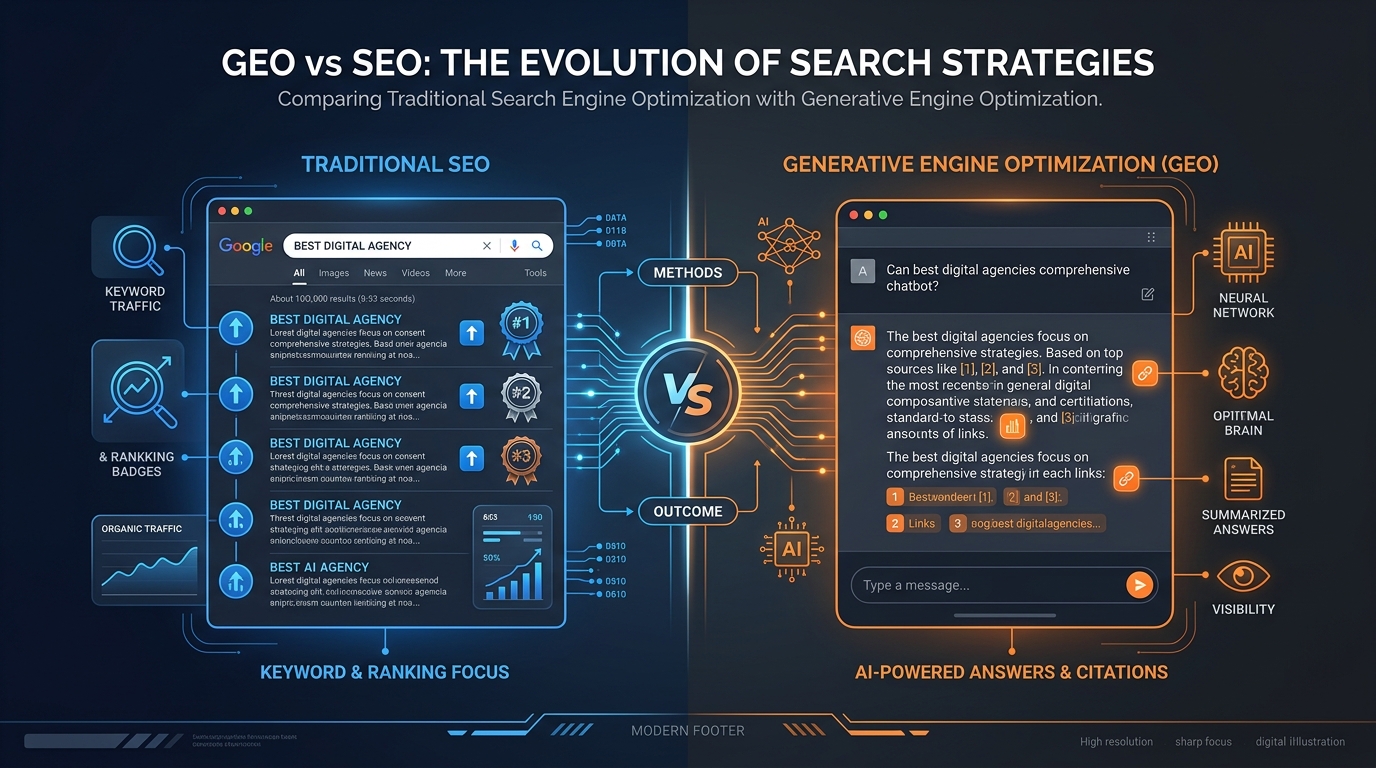

Generative Engine Optimization (GEO) is the practice of getting your content cited in AI-generated answers. It is not a replacement for SEO. It is the next layer on top of it.
In this guide you will learn how to structure content to be easy for AI to quote. We will keep it practical, with clear steps, visual breakdowns, and specific actions you can take today. The first step in any AI visibility project is to run a free AI crawler check on your website so you know exactly where you stand against the 196 bots we track across 8 categories.
Key Takeaways
- GEO and SEO share most of their foundation, but the differences decide AI citations.
- Citability, authority, and crawl access are the three pillars that matter most.
- You can measure progress with an AI Visibility Score and AI referral tracking.
- Start with a free baseline using the free AI crawler check.
The Uncomfortable Part of Content Citability
Advice about writing for AI usually reduces to writing more clearly, which is fine and is not the point. Clarity helps a human reader who has the whole page in front of them. Citability is a different property: whether a passage still means what you intended after it has been separated from the page, the heading, and every sentence around it. Well written prose can be entirely uncitable, and slightly plainer prose can be highly citable, which is why this cannot be delegated to a style guide.
Content citability is really a test of whether a passage can be quoted without being wrong. A retrieval system lifts a chunk and a model writes from it, so anything your paragraph was relying on for meaning is gone at the moment it counts. Pronouns lose their referents, a claim loses the condition that qualified it two paragraphs up, and a figure loses the definition that made it accurate. The paragraph that survives this treatment is the one that carries its own subject, its own qualification and its own scope, and writing that way is a structural habit rather than a matter of tone.
Where the Leverage Is in Content Citability
Name the subject in the sentence, never upstream of it
The single highest-value habit is refusing to open a paragraph with a pronoun or a back-reference. A paragraph beginning with a phrase like it also means or so the sequence reads perfectly in place and becomes meaningless when lifted, because the antecedent was in the previous paragraph. We hit this exact defect in our own content library and had to add an automated check that rejects it, precisely because the prose looked correct while reviewing the page and broke as soon as a passage stood alone. Name the thing every time, even when repetition feels clumsy.
Keep the qualification inside the claim it qualifies
A sentence that is true only for a particular case has to say so in the same sentence, because the sentence establishing the case will not travel with it. If the advice applies to server-rendered sites, or only above a certain traffic level, put that inside the claim. This is where uncitable writing becomes actively risky rather than merely ineffective: an unqualified version of a qualified claim is a false statement with your name attached, and you will not see it happen.
Make the first sentence carry the answer, and let the rest support it
Within a paragraph the useful order is answer, then condition, then reasoning. If a chunk boundary lands mid-paragraph, the part most likely to survive is the beginning, so putting the conclusion there is a hedge against a process you cannot observe. It also makes the paragraph better for a skimming human, which is the general pattern in this subject: the habits that make passages retrievable are mostly the habits that make them readable, just applied more strictly than a style guide would demand.
Add one specific per passage that nothing else has
A passage that restates the consensus has no reason to be chosen over the many others saying the same thing. A number you measured, a named constraint, a version, a date, a threshold: any of these gives a reranking step something to prefer. This is also the part that cannot be produced by writing more carefully, which is why it is the highest leverage and the most neglected. If you have nothing specific to add on a topic, the honest conclusion is that the passage is not worth publishing.
The Citability Mistake That Costs Most
Optimising for a smooth reading experience across the whole page, at the cost of every individual paragraph
This is the trap for good writers specifically. Skilled prose distributes meaning across a passage: a claim is set up, qualified later, and resolved at the end, and the effect on a reader moving through it is excellent. Under chunked retrieval that same structure guarantees that no single piece carries a complete thought, so the page reads beautifully and gets quoted badly or not at all. The fix is not to write worse. It is to make each paragraph independently complete and then use transitions for flow, so removing any one paragraph leaves both it and the page intact. Test it by reading a random paragraph in isolation and asking whether it is still true.
What to Confirm Before You Trust Your Citability
The check that matters here: Pick three paragraphs at random from an important page and read each one alone. For each, ask whether the subject is named, whether the conditions on the claim are present, and whether it says anything the rest of the internet does not. A paragraph failing any of the three is a paragraph that cannot be safely quoted.
Where to Go From Here
Citability is one piece of a larger picture. The AI crawler directory documents every crawler we track with its operator, purpose and safety rating, and the batch URL checker audits many sites in one pass if you manage a portfolio.
Turn the guidance above into a concrete change, then confirm it worked. An AI crawl checker shows you exactly which of the 196 bots can reach your content today.
Your Citability Action Checklist
Five concrete steps, specific to what this guide covered. Work through them in order, changing one thing at a time so you can tell which change produced the result.
- □Establish a baseline with an AI crawler test and write down the score before you change anything.
- □Apply the single highest-impact change from this guide, on its own, so you can attribute the result.
- □Validate the change with the robots checker before it reaches production.
- □Re-measure and compare against your baseline rather than against expectation.
- □Schedule a recurring re-check, because redesigns and security updates quietly undo this work.