
Generative Engine Optimization (GEO) is the practice of getting your content cited in AI-generated answers. It is not a replacement for SEO. It is the next layer on top of it.
In this guide you will learn GEO from scratch and where to start. We will keep it practical, with clear steps, visual breakdowns, and specific actions you can take today. The first step in any AI visibility project is to run a free AI crawler check on your website so you know exactly where you stand against the 196 bots we track across 8 categories.
Key Takeaways
- GEO and SEO share most of their foundation, but the differences decide AI citations.
- Citability, authority, and crawl access are the three pillars that matter most.
- You can measure progress with an AI Visibility Score and AI referral tracking.
- Start with a free baseline using the free AI crawler check.
What the Standard Advice on GEO Misses
Most introductions to GEO open by declaring that SEO is dead and a new discipline has replaced it, which is both wrong and unhelpful to somebody trying to work out what to do on Monday. Nearly everything that makes a page findable by a search crawler also makes it readable by a retrieval system, because both start by fetching the page and parsing the text. The genuinely new part is narrower than the marketing suggests, and knowing exactly how narrow is what saves you from rebuilding things that were never broken.
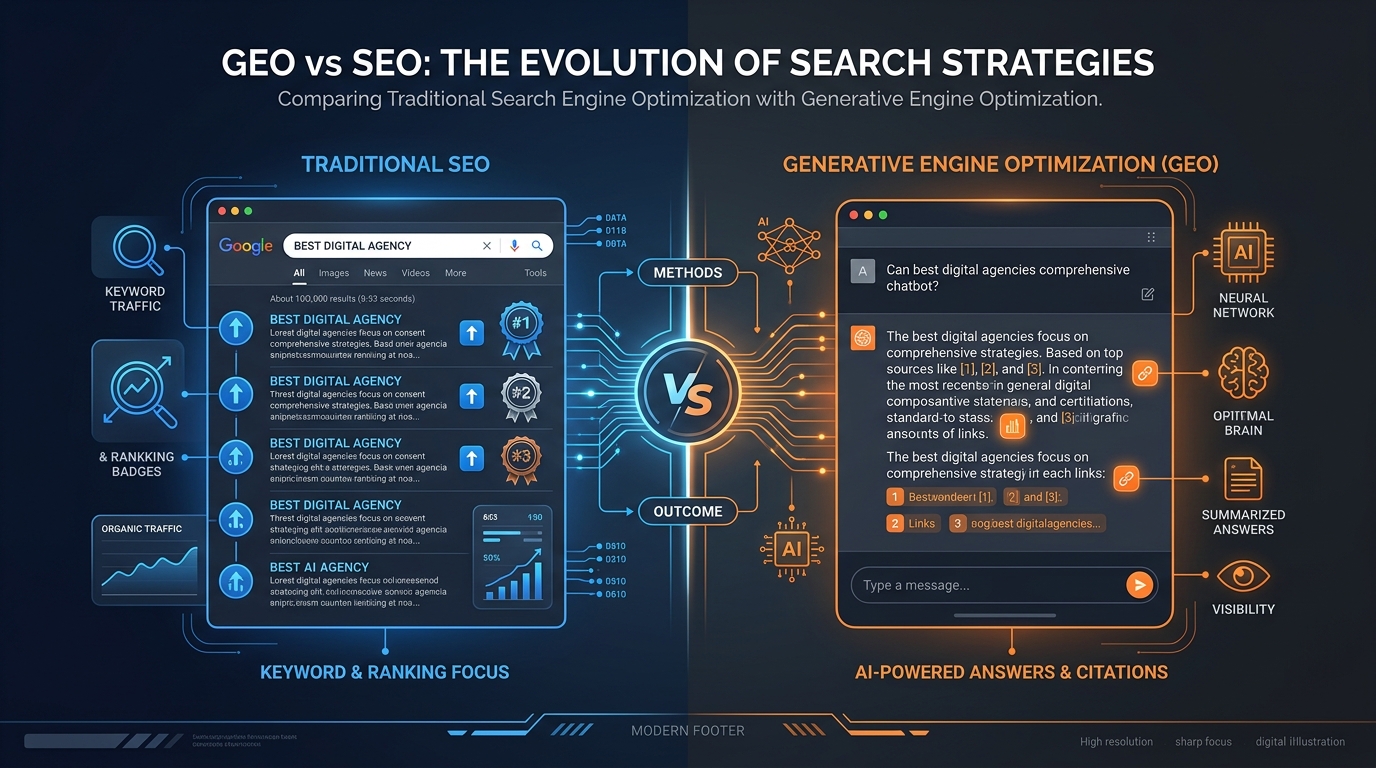
Generative engine optimization differs from search optimization in what counts as a win. A search result gives you a ranked link and the click is yours to earn with a title and a description. A generative answer may quote you, paraphrase you, name you without linking, or use your page to form a view and cite somebody else. So the unit of success moves from the ranked position to the sentence a model can lift out and stand behind, and the practical consequence is that you optimise passages rather than pages. That single shift explains most of what follows, and it is a shift in emphasis rather than a new technical stack.
The GEO Decisions That Actually Matter
Start with access, because it is the only part that is binary
Before any writing decision matters, a retrieval system has to be permitted to fetch the page. That is the one part of this subject with a definite answer: either the crawler is allowed and the page returns content, or it is not. Our own scoring puts bot access at seventy points out of a hundred for exactly this reason, and the softer signals share the remaining thirty. If a retrieval crawler is disallowed in robots.txt, no amount of restructuring or schema compensates, and every hour spent on the rest is spent on a page nothing can read. Check access first, confirm it, then move on.
Do not begin by publishing a file
The most common beginner sequence is to publish llms.txt, tick it off, and feel started. It is a reasonable low-cost hedge and it is not a first move, because no major AI operator has confirmed that any such file is a retrieval or ranking input. Our own changelog says this in plain terms and weights the whole AI infrastructure category at fifteen points as a result. Publishing the file is fine. Believing it is the lever is what leaves people with a tidy checklist and no citations.
Separate what is verifiable from what is inferred, and keep the labels on
This subject is full of confident claims about how retrieval works, and the operators publish almost none of them. It helps to sort every tactic you read into one of three buckets: mechanically verifiable from outside, documented by the operator, or inferred from observed behaviour. Most GEO advice sits in the third bucket, which does not make it worthless, but it does mean you should spend proportionally and be ready to be wrong. The habit of labelling as you read is more valuable than any individual tactic in this post.
Expect attribution without traffic, and decide in advance whether that is acceptable
A generative answer can use your material and send you nobody. If your commercial model requires the click, that is a strategic problem no amount of GEO fixes, and you should know it before you invest. If brand presence in the answer has value on its own, being quoted without a visit is a partial win. Deciding which of those you are optimising for changes what you measure, and doing it now prevents the familiar outcome of a successful GEO programme that the business reads as a failure.
The Failure Mode to Watch For in Generative Engine Optimization
Treating GEO as a replacement for technical SEO rather than a layer on top of it
The damage here is not wasted effort, it is neglect. Somebody reads that the old rules no longer apply, stops maintaining the fundamentals, and quietly loses the thing that was working. Then the pages that were serving cleanly start rendering client-side, the sitemap goes stale, the robots.txt picks up a rule nobody reviews, and both search and AI visibility decline together. GEO is additive: it changes what you write and how you structure a passage, and it does not repeal the requirement that a crawler can fetch a page and read the text. Keep the fundamentals, then add the passage-level work on top.
How to Know You Got Your GEO Right
The check that matters here: Take the one question you most want to be cited for, and find the single passage on your site that answers it. If you cannot point at a specific paragraph, or if the paragraph only makes sense with the surrounding page, you have a page about the topic and not yet an answer to the question.
Where to Go From Here
GEO is one piece of a larger picture. The AI bot directory documents every crawler we track with its operator, purpose and safety rating, and the multi-site crawler check audits many sites in one pass if you manage a portfolio.
Turn the guidance above into a concrete change, then confirm it worked. An AI bot access checker shows you exactly which of the 196 bots can reach your content today.
Your GEO Action Checklist
Five concrete steps, specific to what this guide covered. Work through them in order, changing one thing at a time so you can tell which change produced the result.
- □Establish a baseline with an AI bot access checker and write down the score before you change anything.
- □Apply the single highest-impact change from this guide, on its own, so you can attribute the result.
- □Validate the change with the robots.txt check before it reaches production.
- □Re-measure and compare against your baseline rather than against expectation.
- □Schedule a recurring re-check, because redesigns and security updates quietly undo this work.