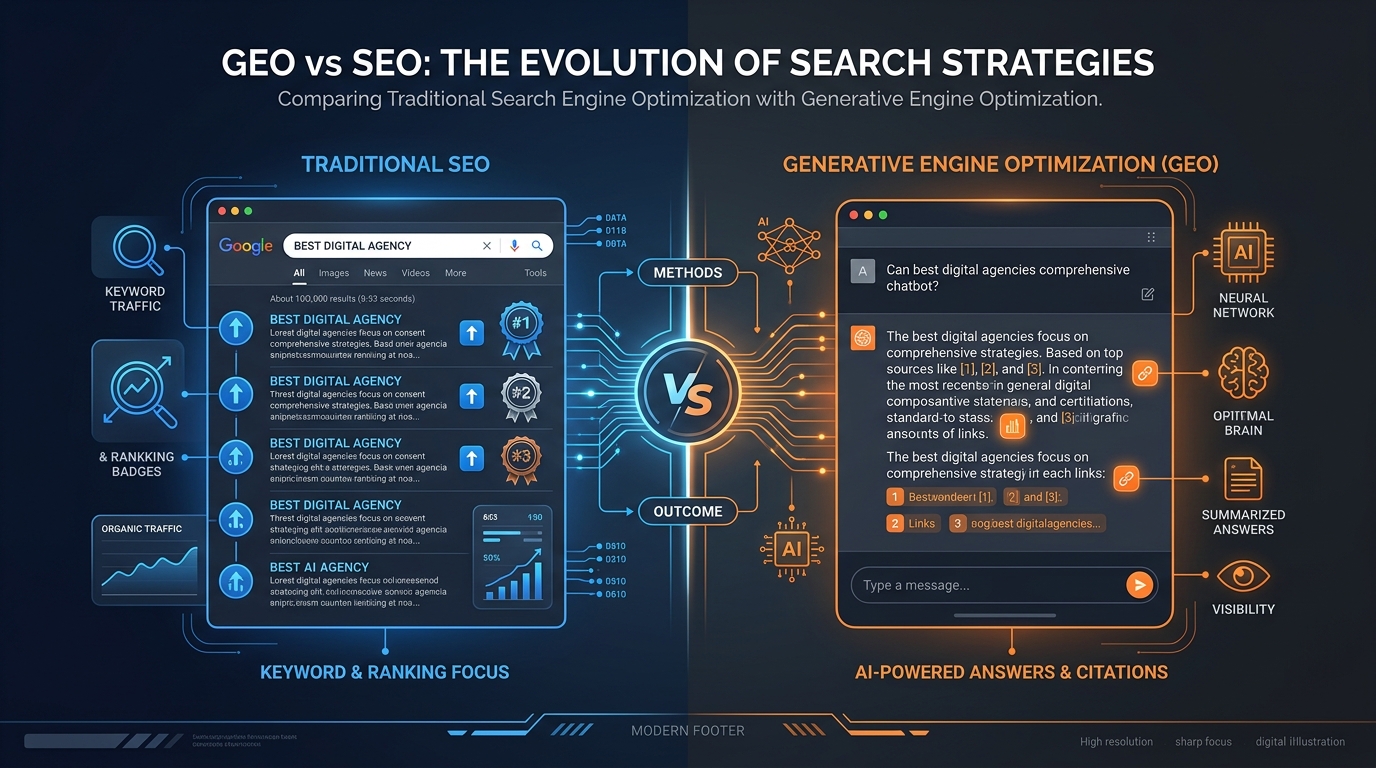

Generative Engine Optimization (GEO) is the practice of getting your content cited in AI-generated answers. It is not a replacement for SEO. It is the next layer on top of it.
In this guide you will understand the source-selection logic of LLMs. We will keep it practical, with clear steps, visual breakdowns, and specific actions you can take today. The first step in any AI visibility project is to run a free AI crawler check on your website so you know exactly where you stand against the 196 bots we track across 8 categories.
Key Takeaways
- GEO and SEO share most of their foundation, but the differences decide AI citations.
- Citability, authority, and crawl access are the three pillars that matter most.
- You can measure progress with an AI Visibility Score and AI referral tracking.
- Start with a free baseline using the free AI crawler check.
Why There Is No Simple Answer on Source Selection
The question of how an AI engine picks its sources gets answered as though a model were browsing the web and forming preferences. That is not what happens, and the mental model matters because it changes what you would work on. In most production systems the model does not choose sources at all. A retrieval step selects candidate passages, and the model then writes an answer from what it was handed, which means much of what people describe as the model liking a source is really the retrieval step matching a passage.
Source selection has more steps than most write-ups admit, and each step can eliminate you for a different reason. A page has to be fetchable, its text has to be extractable, a passage has to match the interpreted query well enough to be retrieved, that passage has to survive being reranked against competitors, and finally the answer has to attribute it. Being excellent at one step buys nothing if you fail an earlier one, and the steps fail silently and invisibly from outside. That is why identical-looking pages get different outcomes and why single-tactic explanations of AI citation keep disappointing.
What to Settle About Source Selection, in Order
The query the system searches is not the question the user typed
Assistants routinely rewrite, expand or decompose a question before retrieving anything, so the text being matched may be several reformulations of the original. This is why optimising a page for one exact phrase works less reliably here than in search: you are trying to match a family of paraphrases you cannot see. Covering the question in the natural vocabulary of the subject, including the words a practitioner would use, is more robust than tuning for a single string.
Retrieval works on passages, so your unit of competition is the paragraph
The candidate set is generally made of chunks rather than whole documents, and a chunk arrives without the page around it. A paragraph that depends on the heading above it, or on a sentence three paragraphs earlier, loses its meaning at exactly the moment it is being judged. This is the mechanical reason self-contained paragraphs outperform elegant flowing prose in this context, and it has nothing to do with a model preferring simple writing.
Reranking is where near-duplicates lose, and it is why thin coverage fails
When several passages answer the query, something has to order them. A passage that answers the question directly, and adds a specific that the alternatives lack, has a reason to be chosen. A passage that restates the consensus in slightly different words does not, however well written it is. This is the most useful practical consequence of the whole pipeline: originality of substance beats quality of phrasing, because phrasing is what everyone already has.
Attribution is a separate step, and it can drop you after you have won
Being retrieved and used is not the same as being named. Whether a citation appears, how many appear, and which of several contributing sources gets credited are decisions made after the answer is drafted, and they vary by product and by interface. So a source can materially shape an answer and receive no visible credit, which is invisible from your side and looks identical to not being retrieved at all. Any measurement you build has to account for that gap rather than assume absence means failure.
The Source Selection Mistake That Costs Most
Concluding that the model dislikes your site when an earlier mechanical step is eliminating you
This misdiagnosis is costly because it sends the work in the wrong direction for months. The symptom is simply absence, which looks like a content quality problem, so people rewrite, add authority signals, and rewrite again. Meanwhile the actual cause is often that the content is injected client-side and the fetched HTML is nearly empty, or a retrieval crawler is disallowed, or the answer is inside a tab that only renders on interaction. Those are all cheap to check and all invisible if you assume the problem is taste. Walk the pipeline in order and confirm each step before touching the prose, because the early steps are the ones you can actually verify.
How to Tell If Your Source Selection Holds Up
The check that matters here: Fetch one of your important pages the way a crawler would, with no JavaScript, and read what comes back. Then take a single paragraph out of it, show it to somebody with no context, and ask what question it answers. Those two checks correspond to the two steps that eliminate most pages.
Where to Go From Here
Source Selection is one piece of a larger picture. The AI bot directory documents every crawler we track with its operator, purpose and safety rating, and the bulk URL checker audits many sites in one pass if you manage a portfolio.
Turn the guidance above into a concrete change, then confirm it worked. An AI crawl checker shows you exactly which of the 196 bots can reach your content today.
Your Source Selection Action Checklist
Five concrete steps, specific to what this guide covered. Work through them in order, changing one thing at a time so you can tell which change produced the result.
- □Establish a baseline with an AI crawler checker and write down the score before you change anything.
- □Apply the single highest-impact change from this guide, on its own, so you can attribute the result.
- □Validate the change with the robots.txt check before it reaches production.
- □Re-measure and compare against your baseline rather than against expectation.
- □Schedule a recurring re-check, because redesigns and security updates quietly undo this work.