

AI search engines do not rank content. They choose content. When someone asks ChatGPT, Perplexity, or Google AI Overviews a question, the engine picks 2 to 5 sources to build its answer. Every other website is invisible. The question is: how does the AI decide which sources to trust?
The answer is E-E-A-T: Experience, Expertise, Authoritativeness, and Trustworthiness. But E-E-A-T in AI search works very differently from traditional Google SEO. In Google organic results, E-E-A-T nudges your page up or down among 10 results. In AI search, E-E-A-T is a binary gate: you either pass the trust threshold and get cited, or you do not exist in the answer.
This guide explains exactly how E-E-A-T works in AI search, what signals AI engines actually look for, and the practical steps you can take to build the authority that gets your content cited. Before diving into E-E-A-T optimization, make sure AI crawlers can actually reach your content. Check your AI bot access status for free to identify any blocking issues.
E-E-A-T in Traditional SEO vs AI Search
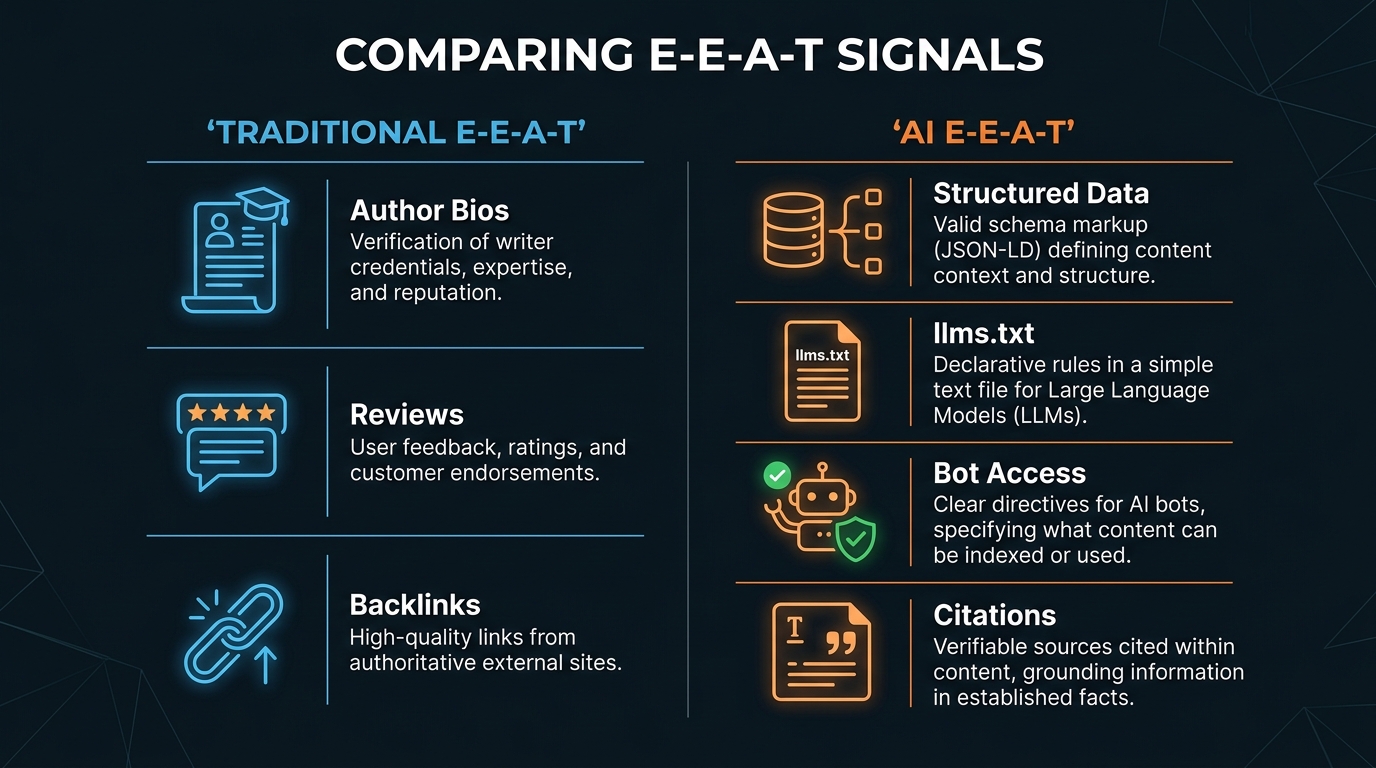
Google introduced E-E-A-T as part of its Search Quality Rater Guidelines. Human quality raters use these signals to evaluate search results. In traditional SEO, E-E-A-T has always been an indirect ranking factor.
AI search engines treat E-E-A-T fundamentally differently:
| Factor | Traditional Google SEO | AI Search (ChatGPT, Perplexity) |
|---|---|---|
| Role of E-E-A-T | Ranking signal (nudges position) | Trust gate (pass/fail for citation) |
| Visibility slots | 10 results per page | 2 to 5 cited sources per answer |
| Competition | Compete for rankings | Compete for citation inclusion |
| Author identity | Nice to have | Often required for citation |
| Original data | Helps with backlinks | Primary reason AI cites a source |
The stakes are higher in AI search because there are fewer slots. In Google, ranking #7 still gets some clicks. In an AI answer, if you are not one of the 3 cited sources, you get zero visibility.
Key Insight
Before optimizing your E-E-A-T, you need to confirm that AI bots can even access your website. A perfect E-E-A-T profile means nothing if your robots.txt blocks GPTBot, ClaudeBot, or PerplexityBot. Run a free AI crawler check to see your current bot access status and AI Visibility Score.
The Four Pillars of E-E-A-T for AI Search
1. Experience: First-Person Knowledge
The first "E" in E-E-A-T stands for Experience. AI search engines value content created by people who have actually done the thing they are writing about. This is the signal that separates AI-generated fluff from valuable content.
How AI engines detect experience signals:
- First-person language: "In our testing..." "When we implemented..." "After working with 50+ clients..."
- Original screenshots and data: Real tool outputs, dashboards, before/after comparisons
- Specific details: Exact numbers, dates, names of tools used, step-by-step walkthroughs
- Case studies: Real examples with measurable outcomes
For example, when we built the AI Crawler Check tool, we analyzed robots.txt files from over 10,000 websites. That real-world testing gives us first-hand experience in how websites configure their AI bot access, which you can verify by checking any domain for free.
2. Expertise: Deep Topic Knowledge
Expertise means your content demonstrates deep understanding of the subject matter. AI engines look for:
- Technical accuracy: Correct use of terminology, proper explanations of complex concepts
- Comprehensive coverage: Answering the main question plus related sub-questions
- Author credentials: Relevant professional background, certifications, published work
- Topical depth: Multiple articles on related topics showing sustained expertise
Building topical authority is especially important. AI engines prefer to cite sources that have written extensively about a topic. A single article about AI SEO is less likely to be cited than a website with 20+ articles covering different aspects of AI search optimization. That is why sites like our blog publish comprehensive guides on every aspect of AI crawlers, from blocking AI crawlers to schema markup for AI search.
3. Authoritativeness: Recognition from Others
Authority in AI search is about how other websites and entities reference your content. Signals include:
- Backlinks from authoritative domains: .edu, .gov, industry publications
- Brand mentions: Other sites mentioning your brand in relevant contexts
- Citation patterns: Being cited by Wikipedia, industry reports, and news sites
- Social proof: Reviews, testimonials, community recognition
A practical way to build authority is to create genuinely useful free tools that people link to naturally. For instance, the AI Crawler Check tool earns backlinks because it solves a real problem: website owners need to know which AI bots can crawl their content, and there are few free tools that check this.
4. Trustworthiness: The Foundation
Trust is the most important E-E-A-T signal and the foundation of the other three. Trust signals in AI search include:
- HTTPS: Secure connection is a baseline requirement
- Clear authorship: Real author names with verifiable identities
- Accurate content: Claims backed by data, sources cited properly
- Transparency: About page, privacy policy, contact information
- Content freshness: Regular updates with visible last-modified dates
- No deceptive practices: No fake reviews, no hidden affiliations
Technical E-E-A-T: The Signals AI Engines Actually Read
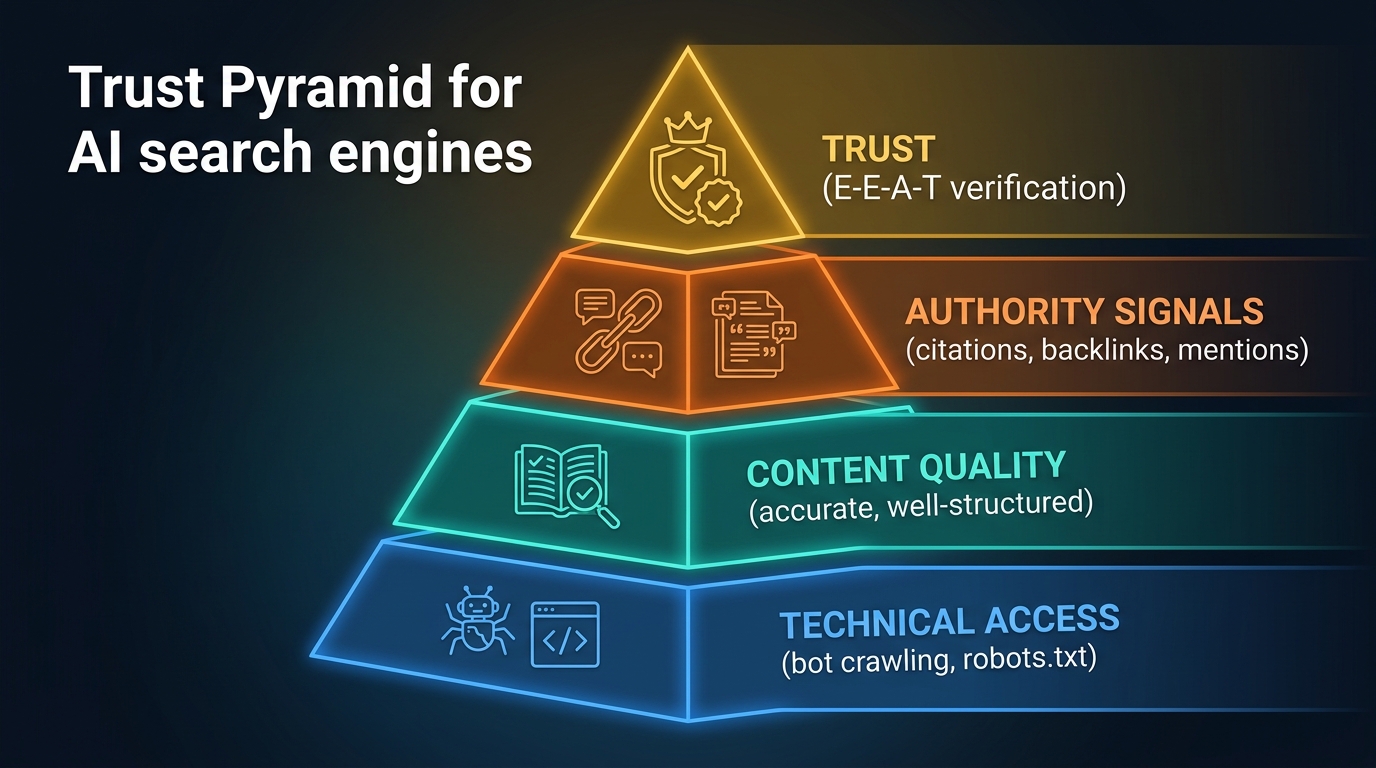
While content-level E-E-A-T is about what you write, technical E-E-A-T is about how your website communicates trust to machines. AI engines rely on structured data and technical signals to verify E-E-A-T claims.
Structured Data for E-E-A-T
Adding schema markup is one of the most effective ways to communicate E-E-A-T signals to AI engines. Key schemas:
{
  "@context": "https://schema.org",
  "@type": "Article",
  "author": {
    "@type": "Person",
    "name": "Brian Ho",
    "url": "https://horatos.ai",
    "jobTitle": "Co-founder & Marketing Director",
    "sameAs": [
      "https://www.linkedin.com/in/ho-bao/"
    ]
  },
  "publisher": {
    "@type": "Organization",
    "name": "AI Crawler Check"
  },
  "datePublished": "2026-03-27",
  "dateModified": "2026-03-27"
}
The most important schemas for E-E-A-T in AI search:
- Article schema: Identifies the author, publisher, dates, and type of content
- Person schema: Links the author to their credentials, social profiles, and expertise
- Organization schema: Establishes the publishing entity's identity
- FAQPage schema: Structures Q&A content for direct AI citation
- HowTo schema: Makes step-by-step content machine-readable
llms.txt for AI Discoverability
One of the newest E-E-A-T signals is the llms.txt standard for AI discoverability. This file tells AI engines exactly what your website is about, who created it, and what content is most important. It is like a structured "About Us" that AI engines can parse instantly. If you do not have one yet, follow our step-by-step guide to creating llms.txt.
AI Bot Access as a Trust Prerequisite
None of your E-E-A-T signals matter if AI crawlers cannot access your content. This is the most common mistake we see: websites invest heavily in content quality but accidentally block the bots that would cite them.
Common Problem
Many websites block GPTBot, ClaudeBot, or PerplexityBot in their robots.txt without realizing it. This makes all your E-E-A-T optimization pointless because the AI engines cannot even read your content.
Solution: Run a free AI crawler check on your domain to see exactly which AI bots are allowed and which are blocked. Fix any blocking issues, then use the Robots.txt Generator to create an optimized robots.txt configuration.
10 Actionable Steps to Build E-E-A-T for AI Search
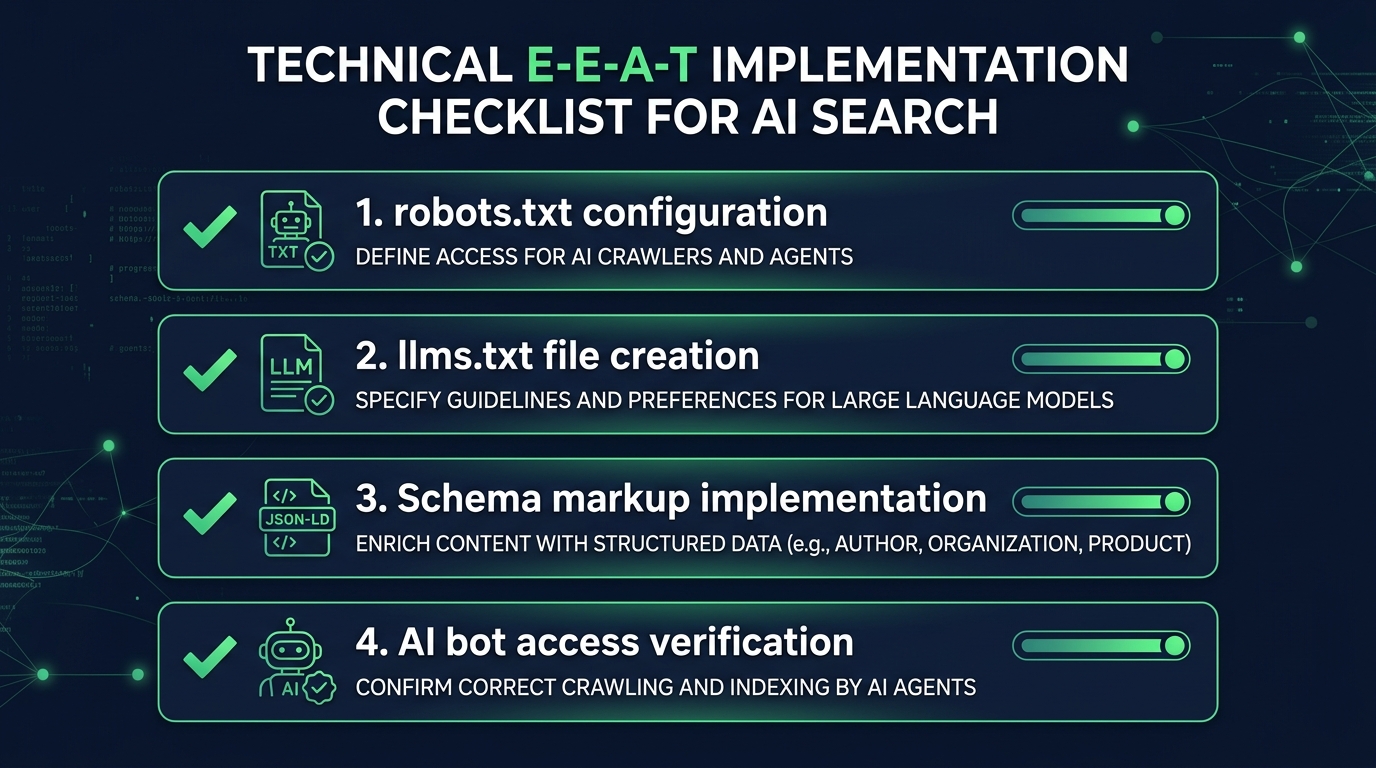
Here is a practical checklist you can follow today. Each step includes why it matters for AI citations and how to implement it.
Step 1: Audit Your AI Bot Access
Start with the foundation. Use the AI Crawler Check tool to see your current AI Visibility Score. This tells you how many of the 88 AI crawlers can access your content. If your score is below 50, you have blocking issues to fix before anything else matters.
Step 2: Create Detailed Author Pages
Every content creator on your site needs a dedicated author page with: full name, photo, professional title, credentials, social media links, and a list of their published articles. Link every article back to the author page. AI engines use this to verify expertise.
Step 3: Add Author Schema Markup
Implement Person schema on author pages and Article schema on every blog post. Use the sameAs property to link to the author's LinkedIn, Twitter, and other professional profiles. This helps AI engines connect the dots. Learn more in our schema markup guide.
Step 4: Include Original Data and Research
AI engines strongly prefer to cite sources with original data. Include real numbers from your own experience, survey results, tool outputs, or case studies. Even simple data like "We analyzed 500 websites and found that 67% block at least one AI bot" gives AI engines a reason to cite you over a competitor who only summarizes others' work.
Step 5: Build Topical Authority
Publish multiple articles on related topics. AI engines favor sites that demonstrate deep coverage of a subject area. If you write about AI SEO, you should also cover robots.txt best practices, AI Overviews optimization, and AI SEO vs traditional SEO.
Step 6: Create an llms.txt File
This is one of the newest and most effective E-E-A-T signals. An llms.txt file tells AI engines who you are, what you do, and which content is most authoritative. It is like handing AI engines your resume and portfolio in a machine-readable format.
Step 7: Show Publish and Update Dates
AI engines prefer fresh, updated content. Always display the original publish date and the last modified date on every article. Include datePublished and dateModified in your Article schema.
Step 8: Write Quotable Content
AI engines need to extract clear, concise statements to include in answers. Write content with "quotable" sentences: direct answers, clear definitions, and specific claims. Use descriptive headings that match how people phrase questions.
Step 9: Add FAQ Sections with Schema
FAQ sections with FAQPage schema are gold for AI citations. AI engines love structured Q&A content because it directly matches conversational queries. Include 3 to 5 relevant FAQs at the bottom of every article.
Step 10: Monitor and Iterate
E-E-A-T optimization is not a one-time task. Regularly run the AI SEO audit checklist to identify gaps. Check your AI Visibility Score monthly to ensure AI bots still have access. Monitor AI bot traffic in your analytics to see which engines visit your site and how often.
Common E-E-A-T Mistakes That Kill AI Visibility
Based on our experience analyzing thousands of websites with the AI Crawler Check tool, here are the most common E-E-A-T mistakes:
Mistake 1: Blocking AI Crawlers
The #1 mistake. Many sites block GPTBot, ClaudeBot, or all AI bots in robots.txt. This makes all E-E-A-T signals invisible to AI engines.
Mistake 2: No Author Information
Publishing content without real author names, bios, or credentials. AI engines cannot verify expertise from anonymous content.
Mistake 3: Regurgitating Others' Content
Rewriting information from other sites without adding original insights, data, or experience. AI engines can detect this and will cite the original source instead.
Mistake 4: Outdated Content
Articles from 2023 or earlier without updates. AI engines strongly prefer content with recent dateModified timestamps, especially in fast-moving fields like AI and technology.
Mistake 5: Missing Structured Data
No Article, Person, or Organization schema. AI engines can still read your content, but structured data gives you a significant advantage over competitors who also have not implemented it.
How to Measure Your E-E-A-T for AI Search
E-E-A-T is not a single number, but you can measure its components:
| E-E-A-T Component | How to Measure | Tool |
|---|---|---|
| AI Bot Access | How many AI bots can reach your content | AI Crawler Check |
| AI Visibility Score | Overall score from 0 to 100 | AI Crawler Check |
| Schema Coverage | Which structured data types are present | Google Rich Results Test |
| Topical Authority | Number of articles on related topics | Manual audit |
| AI Referral Traffic | Visits from AI search engines | Google Analytics + our guide |
| Content Freshness | Average age of published content | CMS dashboard |
Conclusion: E-E-A-T Is the Price of Admission to AI Search
In 2026, E-E-A-T is no longer just a "nice to have" for Google rankings. It is the price of admission to AI search. If your content does not meet the trust threshold, AI engines will not cite you, and you will be invisible in an increasingly AI-driven search landscape.
The good news: building E-E-A-T is not a mystery. It comes down to three things:
- Let AI bots in: Check your AI bot access and fix any blocking issues
- Be genuinely helpful: Create content with original data, real expertise, and clear answers
- Make it machine-readable: Add schema markup, create llms.txt, and structure content for AI consumption
Start with step one: run a free AI crawler check on your website right now. It takes 10 seconds and shows you exactly where you stand. Then work through the 10-step checklist above to build the E-E-A-T signals that get your content cited by AI engines.