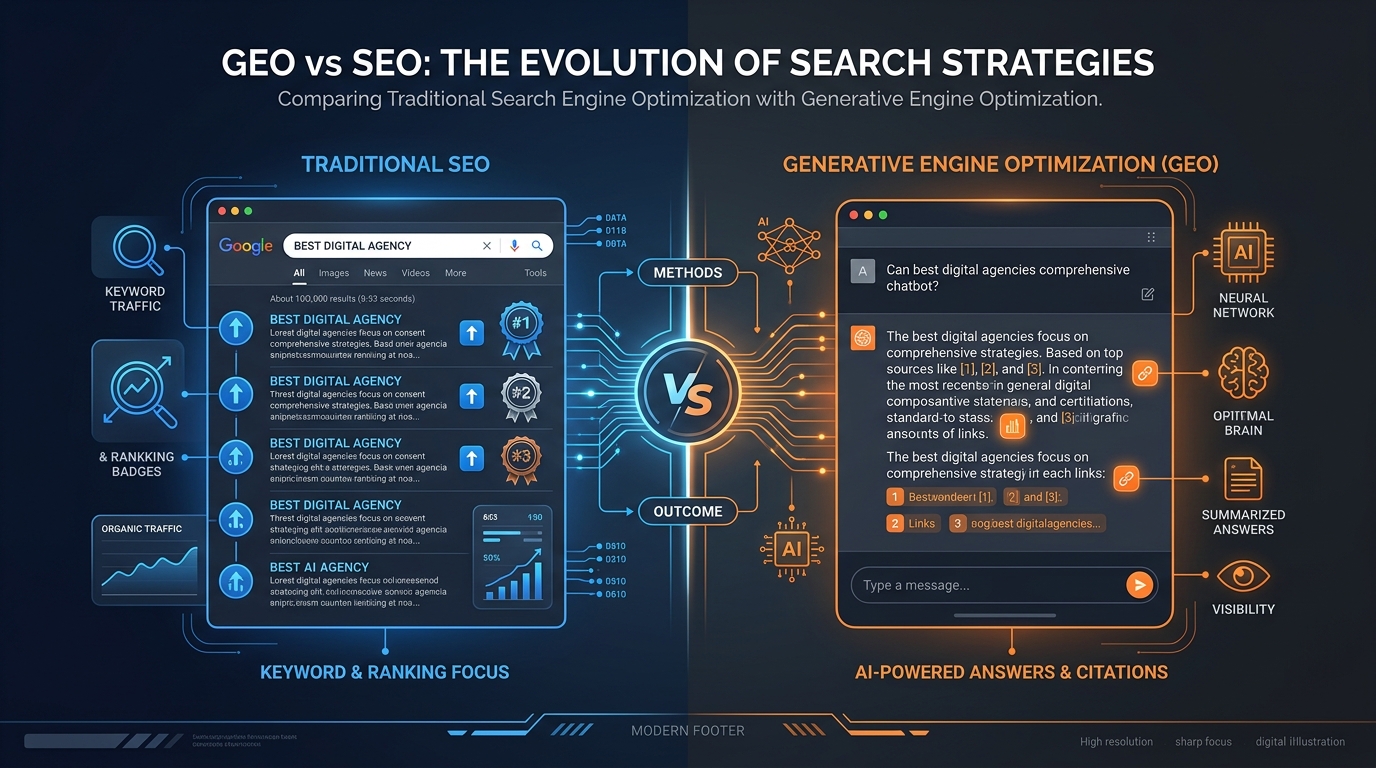

Generative Engine Optimization (GEO) is the practice of getting your content cited in AI-generated answers. It is not a replacement for SEO. It is the next layer on top of it.
In this guide you will know the signals that drive AI citations. We will keep it practical, with clear steps, visual breakdowns, and specific actions you can take today. The first step in any AI visibility project is to run a free AI crawler check on your website so you know exactly where you stand against the 196 bots we track across 8 categories.
Key Takeaways
- GEO and SEO share most of their foundation, but the differences decide AI citations.
- Citability, authority, and crawl access are the three pillars that matter most.
- You can measure progress with an AI Visibility Score and AI referral tracking.
- Start with a free baseline using the free AI crawler check.
The Question Behind GEO Ranking Factors
The phrase ranking factors carries an assumption that does not survive contact with how these systems work: that there is a ranked list with weights, and that knowing the weights tells you what to do. Search had that fiction too, and it was at least anchored in a single operator with one index. Generative answers are produced by several operators, each combining retrieval, their own model behaviour and often a live search index, and none of them publishes a ranking function. Anyone showing you a weighted table has inferred it or invented it.
GEO ranking factors are better understood as gates and tiebreakers than as a weighted list. A small number of things are gates: if the crawler cannot fetch the page, or the text is not in the HTML, nothing downstream happens at all, and no other signal compensates. Everything after that behaves like a tiebreaker among pages that already cleared the gates, which is why the same tactic looks decisive in one case study and irrelevant in another. Sorting the advice into gates first and tiebreakers second gives you a defensible order of work even though nobody outside the operators knows the weights.
The Four Parts of GEO Ranking Factors Worth Arguing About
The gates are few, verifiable, and where the work starts
A retrieval crawler must be permitted, the page must return content to a plain fetch, and the answer must be present in the HTML rather than assembled by JavaScript afterwards. Each of those is checkable from outside in minutes and each is binary. Our own scoring reflects that asymmetry by giving bot access seventy of a hundred points, with technical readiness at fifteen split as sitemap six, structured data six and HTTPS three. Those are our weights and we publish the reasoning; they are not a claim about any operator formula.
Treat every softer signal as a tiebreaker with unknown weight
Clear headings, direct answers, dates, named authors, cited sources, structured data: these are all plausible and none is confirmed as an input by the operators. That is not an argument against doing them, because they are cheap and they help human readers too. It is an argument against ranking them. Do the cheap ones broadly rather than betting a quarter to make one of them excellent, because the payoff distribution across them is genuinely unknown.
Prefer signals that are also true, because unverifiable ones decay
A signal that a system can check against reality is durable. A date that reflects a real update, an author who genuinely has the credential, a statistic that resolves to a real source: these keep working. Signals that merely look right are the ones that stop working when detection improves, and they take the surrounding page down with them. If you would be uncomfortable having a claim checked, it is a liability rather than an optimisation.
Watch for factors that are really the same factor twice
Much of the published advice double counts. Answer-first structure, clear headings and short self-contained paragraphs are three descriptions of one underlying property, which is whether a passage can be lifted out and still make sense. Fixing that property once satisfies all three, and treating them as separate line items inflates the work while producing no additional benefit. When two factors on your list cannot be improved independently, they are one factor.
The Failure Mode to Watch For in GEO Ranking Factors
Building a scorecard from a published factor list and then optimising the scorecard
This fails in a specific and expensive way. The list gets turned into a spreadsheet, the spreadsheet gets a total, and the total becomes the target. Because the softer factors are numerous and cheap to tick, the score rises steadily while the gates go unexamined, and a site can reach a high internal score with a retrieval crawler still disallowed. The score is then actively harmful, because it is the evidence people cite for not looking further. Keep gates and tiebreakers in separate sections that cannot be added together, so a good tiebreaker total can never disguise a failed gate.
The GEO Ranking Factors Test Worth Running Now
The check that matters here: Split your factor list into things that are true or false today and things you are inferring. Verify every item in the first group before spending anything on the second, and if the first group has an unchecked item, that is the whole of this quarter.
Where to Go From Here
GEO Ranking Factors is one piece of a larger picture. The AI crawler directory documents every crawler we track with its operator, purpose and safety rating, and the batch URL checker audits many sites in one pass if you manage a portfolio.
Turn the guidance above into a concrete change, then confirm it worked. An AI crawl checker shows you exactly which of the 196 bots can reach your content today.
Your GEO Ranking Factors Action Checklist
Five concrete steps, specific to what this guide covered. Work through them in order, changing one thing at a time so you can tell which change produced the result.
- □Establish a baseline with an AI crawler checker and write down the score before you change anything.
- □Apply the single highest-impact change from this guide, on its own, so you can attribute the result.
- □Validate the change with the robot checker before it reaches production.
- □Re-measure and compare against your baseline rather than against expectation.
- □Schedule a recurring re-check, because redesigns and security updates quietly undo this work.