
Most AI visibility problems are not content problems. They are technical problems hiding in plain sight. This guide helps you find and fix them.
In this guide you will learn how to manage duplicates so AI cites the right URL. We will keep it practical, with clear steps, visual breakdowns, and specific actions you can take today. The first step in any AI visibility project is to run a free AI crawler check on your website so you know exactly where you stand against the 196 bots we track across 8 categories.
Key Takeaways
- Duplicate Content and Canonicals in AI Search is a practical, repeatable process, not a one-time fix.
- Most AI visibility problems trace back to access, not content.
- You can verify every change with the free AI crawler check and the robots checker.
- Document your approach so the whole team applies it consistently.
A Diagnostic Order That Narrows Fast
Debugging crawler access is a process of elimination, and the sequence below is ordered by how much each check rules out rather than by how likely it is to be the cause.
Reproduce the failure as the bot experiences it
Request the URL with the crawler user-agent and no JavaScript execution, and record the status code and the returned body. A problem you cannot reproduce deterministically cannot be confirmed fixed.
Separate a status-code problem from a content problem
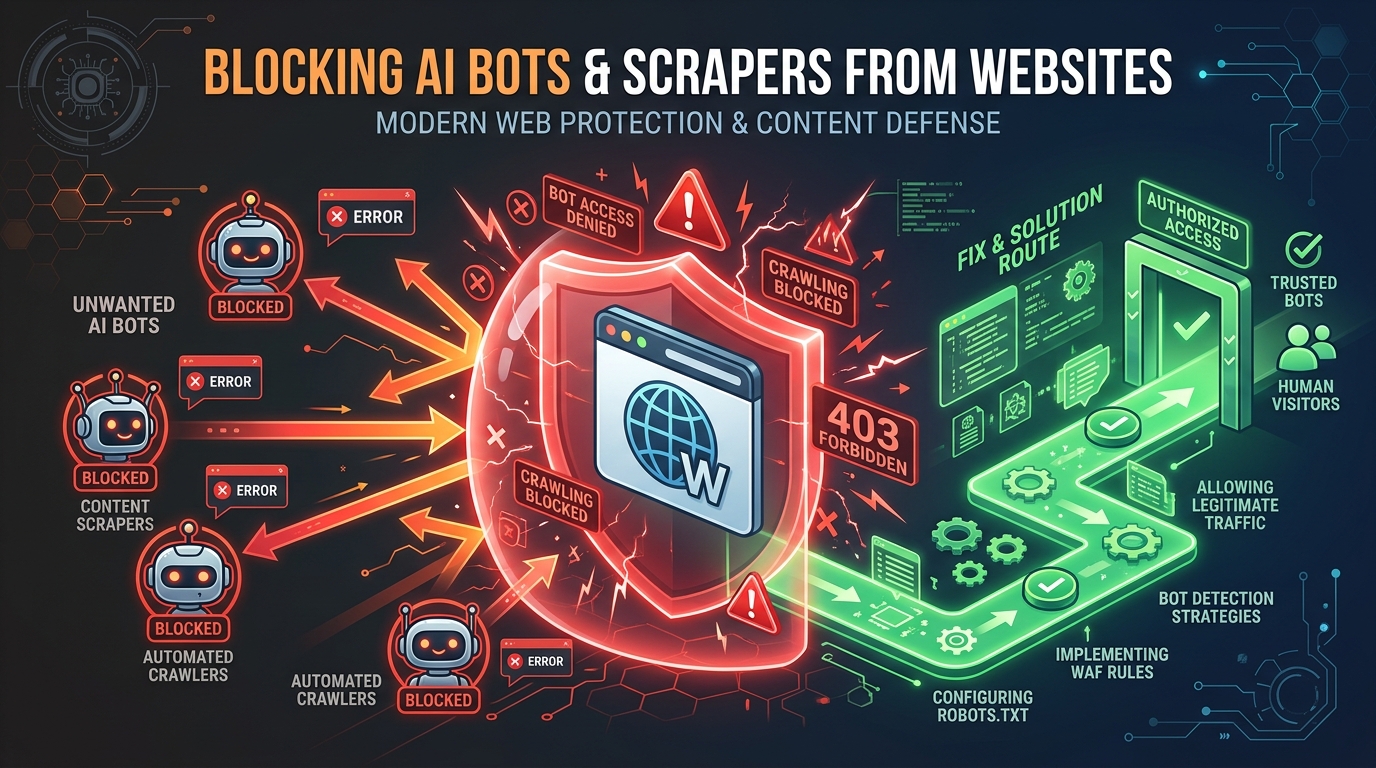
A 403 or 429 is an access decision made by your server or firewall. A 200 that returns an empty shell is a rendering problem. These have nothing in common and mixing them up wastes the most time.
Check the layers in front of your application
CDN rules, WAF policies, rate limits and bot-management features all block crawlers without touching robots.txt, and they are frequently configured by a different team. Run an AI crawler test to see the external result rather than reasoning from your config.
Rule robots.txt in or out explicitly
Test the exact failing path against the live file with a robots checker. If the file permits it, robots.txt is eliminated and you can stop looking there, which is worth doing early precisely because it is cheap.
Fix one layer, retest, then move outward
Changing several layers at once produces a working system with an unknown cause, which will regress. Confirm each fix independently before proceeding.
Why Duplicate Content and Canonicals Are Harder Than They Look
Duplicate content in AI search behaves differently from duplicate content in classical search. Search engines pick a canonical and rank one version. An AI engine assembling an answer from several identical texts has no reason to attribute any of them, so the outcome is not a demoted page, it is an uncited fact.
That shifts the concern from your own duplicates to shared source text. Manufacturer descriptions, syndicated articles, MLS listings and vendor boilerplate are identical across every site using them, and no canonical tag on your domain has any bearing on that. The fix is differentiation, not consolidation.
The Duplicate Content and Canonicals Details That Decide the Outcome
Internal duplication and cross-site duplication need different fixes
Variants of your own page are resolved with canonicals, consistent internal linking and URL normalisation. Text you share with fifty competitors is resolved only by adding something none of them have. Applying the first set of tools to the second problem is common and produces no change, because the tools address a question that is not being asked.
A canonical is a hint, and a contradicted hint is ignored
Canonical tags are advisory. When they conflict with internal links, sitemap entries, redirects or hreflang, engines frequently choose differently and you lose predictability. Consistency across all those signals is what makes a canonical effective, and inconsistency is the normal state of a site nobody has audited.
Differentiation has to be substantive to matter
Rewording shared copy does not create a distinct source, because the underlying claims are the same and an engine is matching meaning rather than strings. What differentiates is new information: your own measurement, your own photography, a limitation you observed, a comparison nobody else published. That is a content investment rather than a technical one.
Near-duplicates across your own site compete with each other
Several pages targeting the same intent split whatever authority you have and give an engine an arbitrary choice. Consolidating them into one stronger page, with redirects from the rest, is usually better than maintaining all of them, and this is where merging genuinely is the right answer.
The Most Expensive Misunderstanding About Duplicate Content and Canonicals
Assuming a canonical tag resolves syndicated duplication
Canonicals are the reflexive answer to any duplicate content question, and they only operate within your own control. Against text shared across dozens of domains they achieve nothing, so the page remains one identical copy among many and continues to go uncited. The tag is correctly implemented and irrelevant, which makes the problem hard to see.
The Duplicate Content and Canonicals Check Worth Keeping in Your Routine
The check that matters here: Take a paragraph from an important page and search for it as an exact phrase. If it appears on other domains, no technical fix applies and the work is to add something only you have.
Where to Go From Here
Duplicate Content and Canonicals is one piece of a larger picture. The full list of AI crawlers documents every crawler we track with its operator, purpose and safety rating, and the batch checker audits many sites in one pass if you manage a portfolio.
Most access failures are invisible from a browser, which is why they persist. Start with an AI crawler test to see which layer is actually returning the block.
Your Duplicate Content and Canonicals Action Checklist
Five concrete steps, specific to what this guide covered. Work through them in order, changing one thing at a time so you can tell which change produced the result.
- □Reproduce the failure with a request that sets the bot user-agent, not your browser default.
- □Work through the layers in order: DNS, firewall, HTTP status, robots.txt, then rendering.
- □Compare the raw HTML response against what you see on screen, because many bots never run JavaScript.
- □Record which layer returned the block before changing anything, so the fix is targeted.
- □Re-test the exact same request after the fix to confirm the status actually changed.